Skanda Sriganesh All work

Debit Conversion

When Capital One acquired Discover in a $35.3B deal, every debit card had to move networks. I designed the servicing experience that made a high-stakes migration feel seamless for millions of cardholders.

01

The problem

Customers didn't ask for this. An unexpected replacement card created doubt about a basic need. Access to their money: recurring payments, digital wallets, merchant acceptance, travel and military timing, even duplicate cards from loss or theft.

The business needed it invisible. Moving debit onto an owned network was strategically critical. But only if the experience stayed low-effort, holding down call volume, escalations and manual servicing at scale.

The happy path was easy to design. The real work was everything that happens when customers don't follow it.

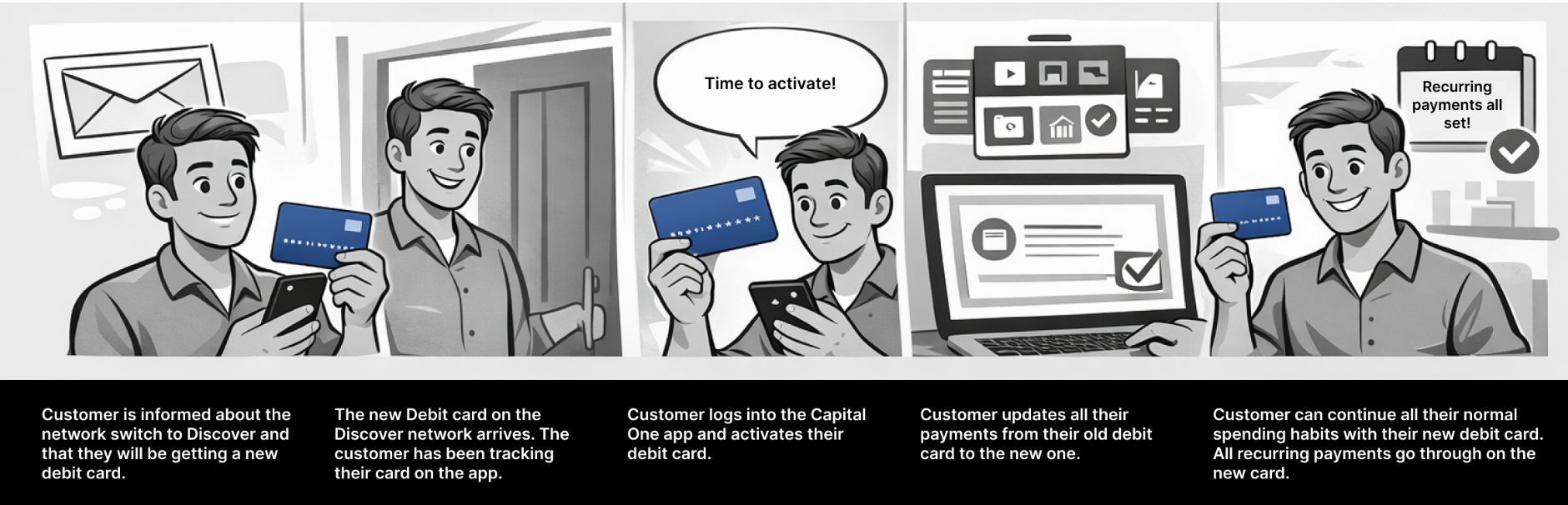
Five-panel storyboard of the happy-path debit conversion journey: the customer is informed of the network switch, the new Discover card arrives, they activate it in the Capital One app, update recurring payments, and continue spending normally.
The happy path, as designed: informed, activated, updated, done.
02

Two paths: self-service, then support

The goal was always self-service in-app. Customers activate their card, update recurring payments, done. No call needed. But millions of real people hit edge cases, and those calls had to work flawlessly as a backup.

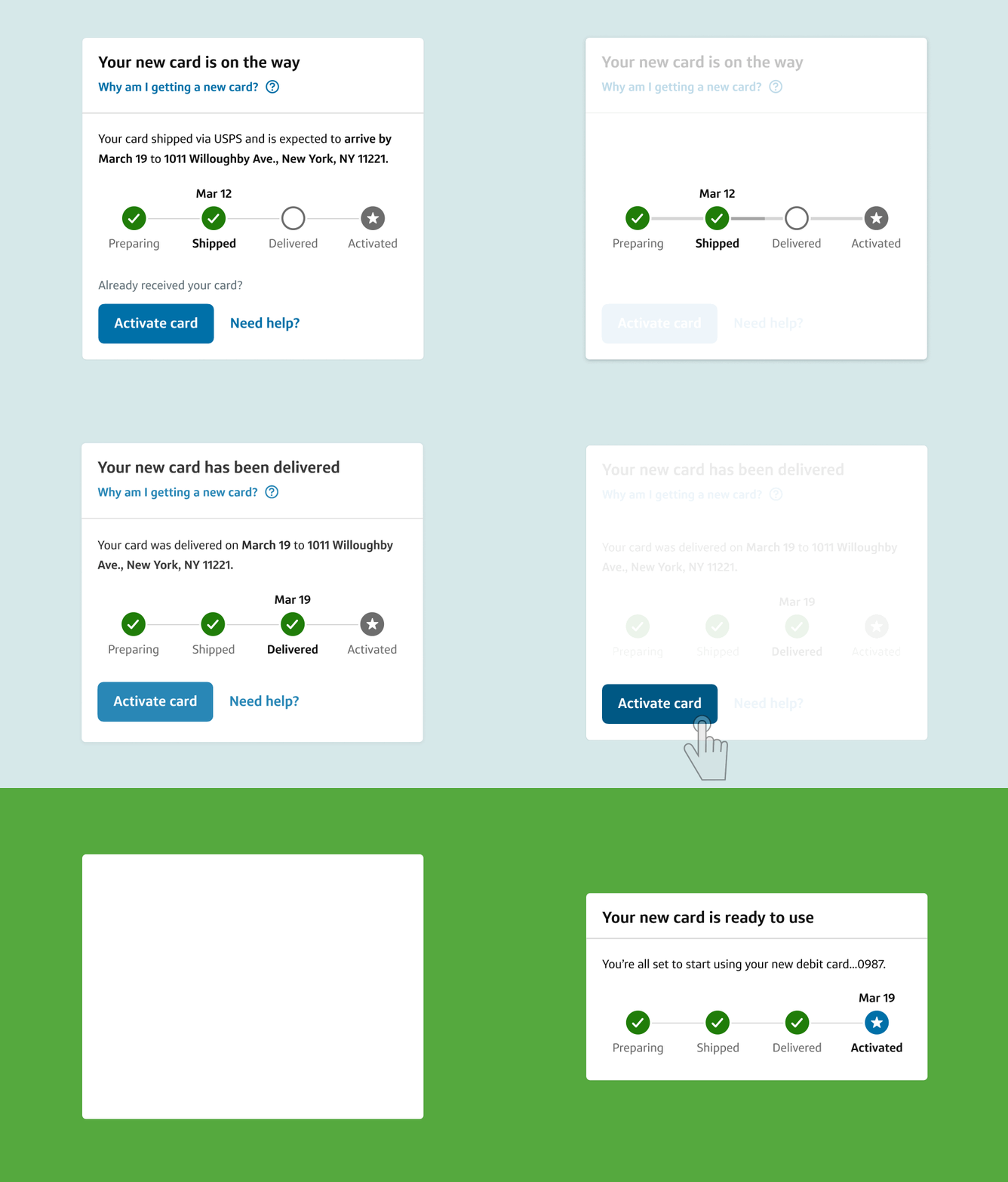
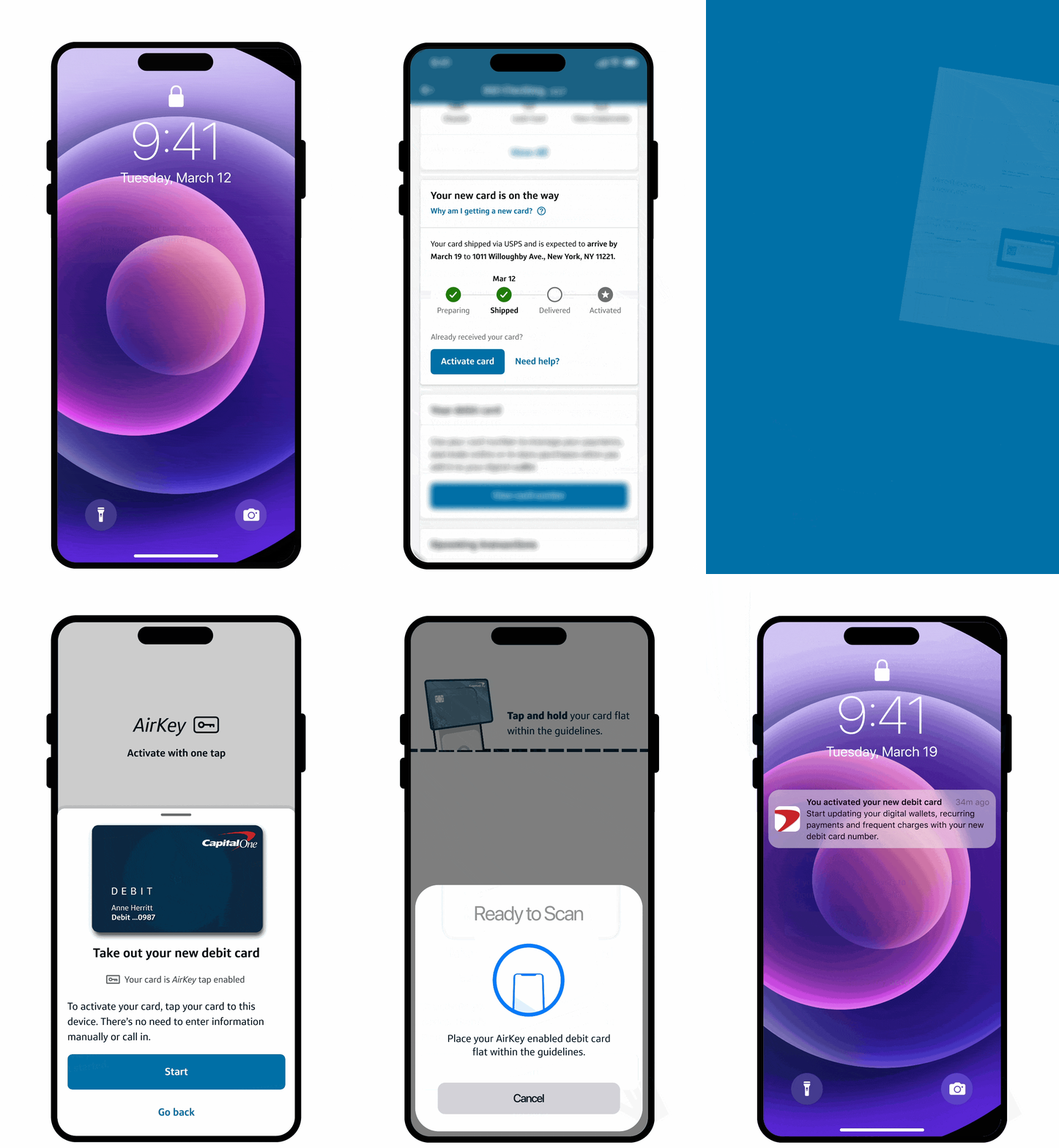
Self-service first: A tracker shows cardholders where their card is: preparing, shipped, delivered, activated. Contextual help and no surprises. Phone support second: When they call in, associates see the customer's conversion state and have a playbook for every path: lost cards, early-issuance requests, travel holds, payment failures.

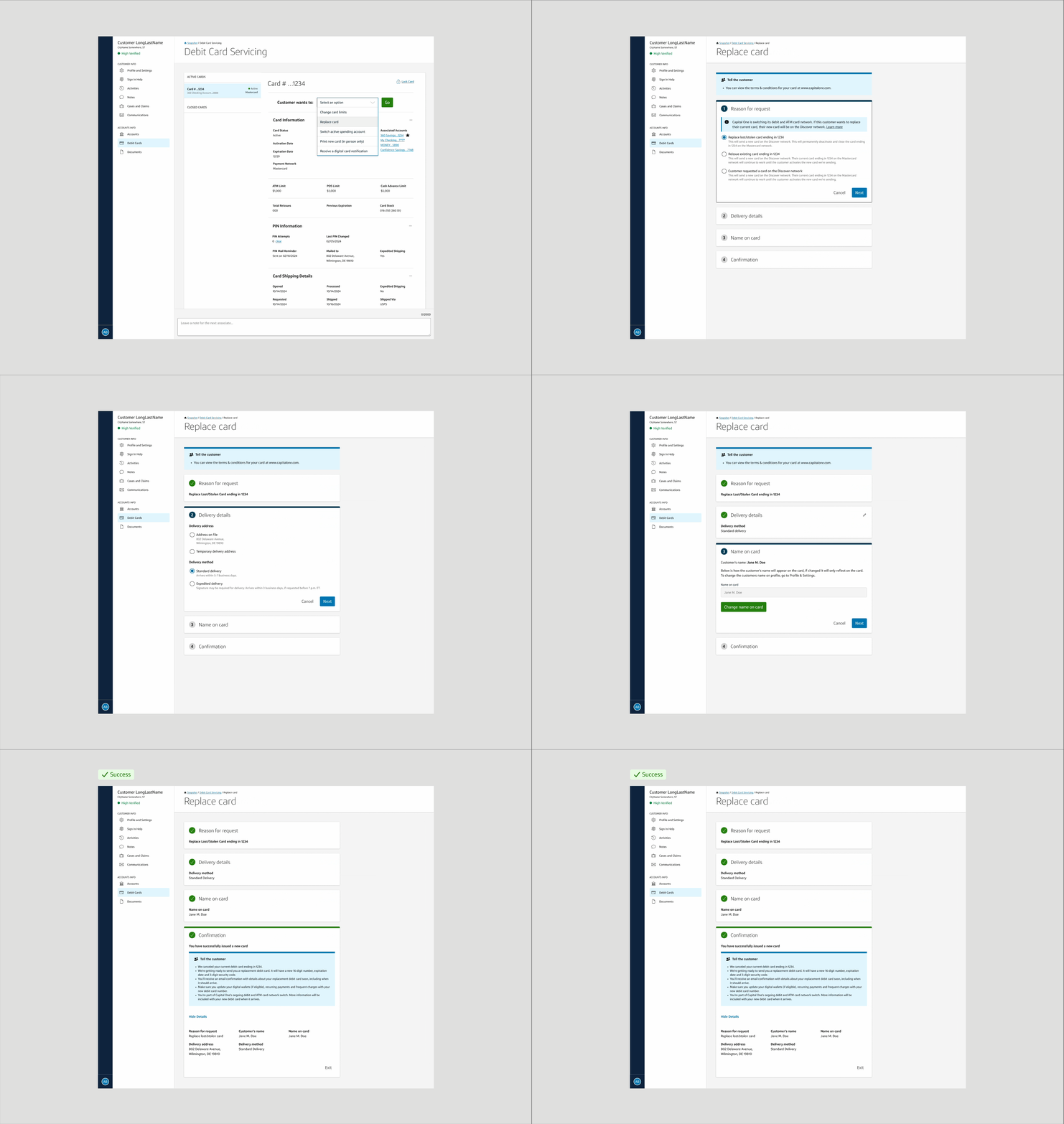
Associate servicing screen for debit card conversion showing customer context, card details, talking points and available actions.
The associate flow had to hold customer context, talking points and next-best actions together, supporting agents while protecting the customer experience.
Mobile app tracker showing card delivery stages: Preparing (green check), Shipped (green check), Delivered (open circle), Activated (gray star). The interface displays shipping info, address confirmation, and action buttons for activation and help.
The in-app tracker: a clear journey from preparing through activation, with help always one tap away.
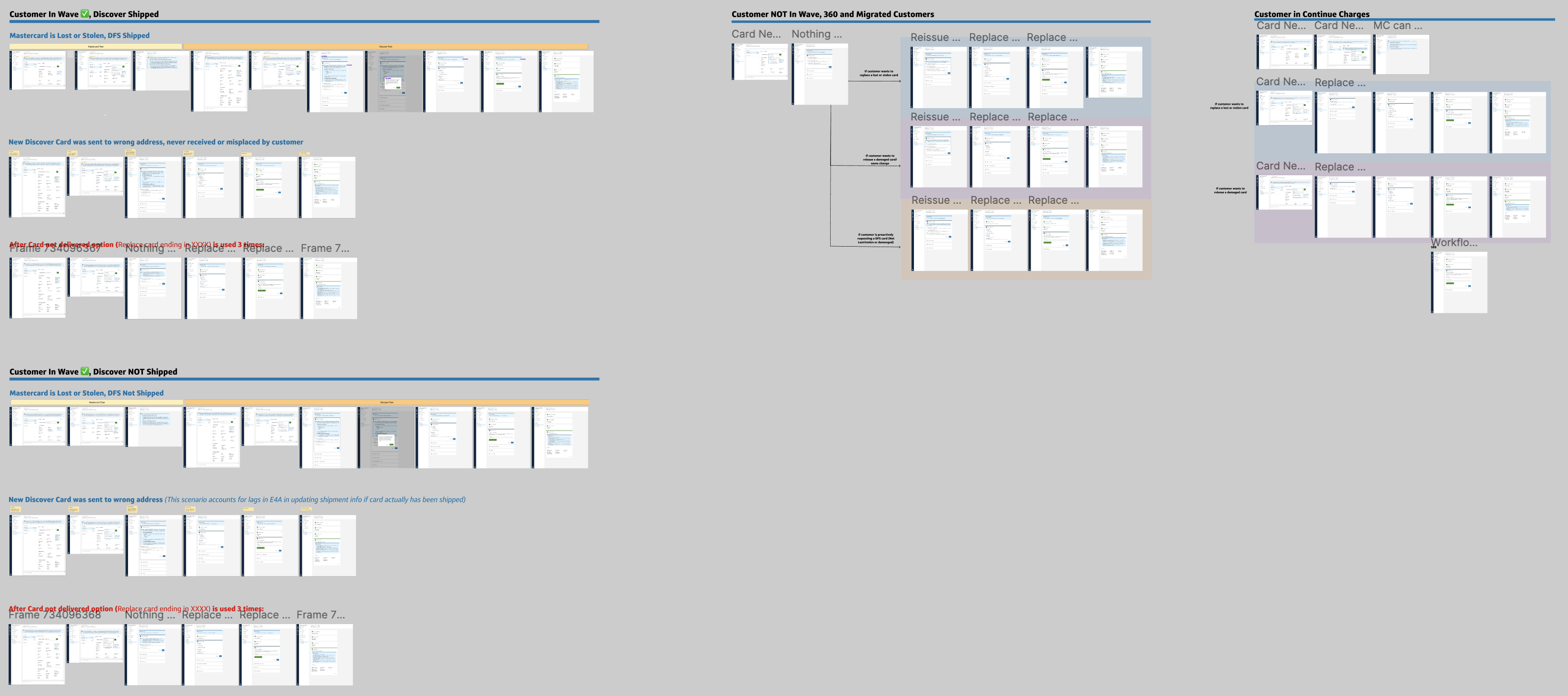
Complex associate servicing map showing three customer segments (In Wave, NOT In Wave/360, Continue Charges) and branching decision flows for lost, stolen and unshipped scenarios, with different action paths and messaging for each.
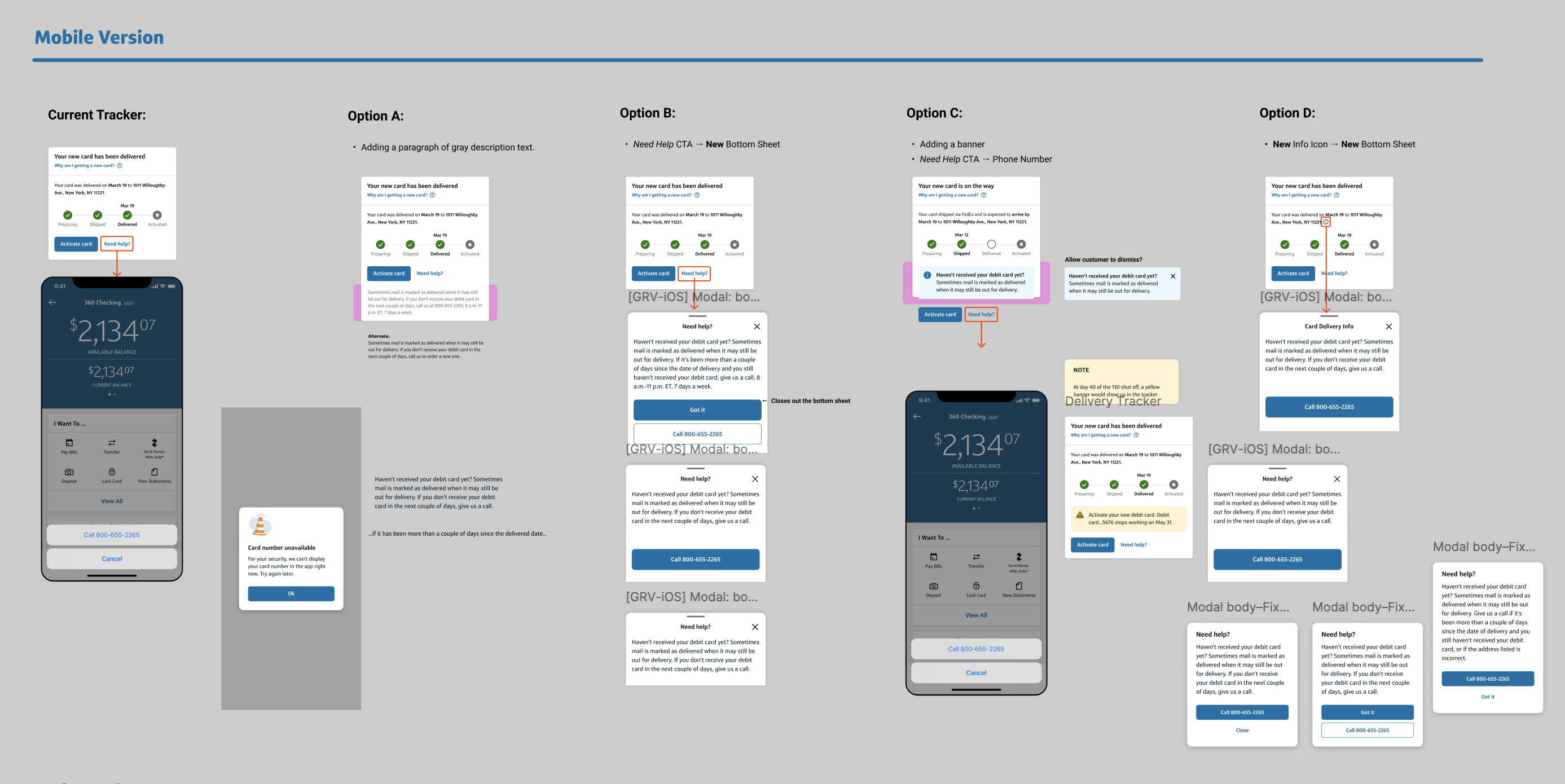
Exploring how to surface tracking info and contextual help across different scenarios and screen states.
03

What I did

I designed both paths: the self-service journey that keeps most customers happy, and the associate servicing tool that catches everyone else.

01

Card tracker with state awareness

Built a timeline customers check in-app: where's my card, why hasn't it arrived, what do I do next? Each stage branches into contextual help, reducing calls by showing shipping details, address confirmation and next steps.

02

Lost or stolen mid-conversion

Enhanced the associate servicing tool to read where a customer sat in the conversion. Prevented duplicate cards and a second round of activation and payment updates.

03

The "not ready yet" exception

Introduced a one-time, risk-constrained way to briefly reactivate the old card. For travel, military service or disasters, so access never lapsed.

Five mobile design options showing different tracker layouts: adding descriptive text, adding help CTAs, bottom sheets, banners, and info icons to test what information density and affordance pattern works best.
The associate playbook: every lost, stolen and edge-case scenario branched by where the customer sits in the conversion, so associates always know the next action.
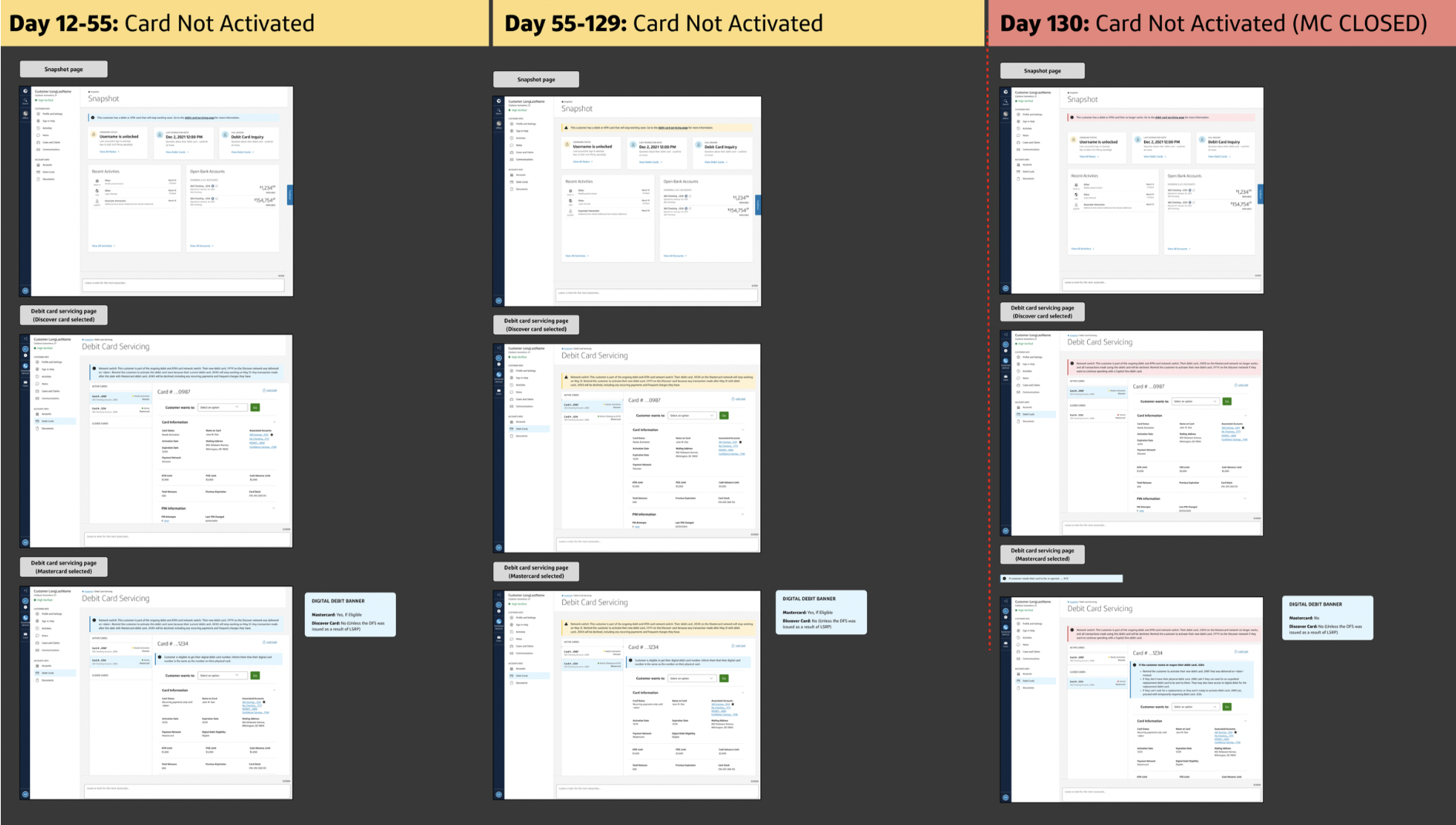
Network change banner timeline: a branching map of every associate banner state across the conversion, from the network announcement and card delivery through the activated continue-charges period, the not-activated day-state branches (Day 12–55, 55–129, 130 MC closed), and back-to-normal.
I mapped every banner state across the journey, Day 0 to Day 130+, happy path and unhappy, so associates always had the next best action.
04

The impact

Live in production and launched incrementally, proof that the edge cases I designed for are actively running at scale.

750K+
Debit cards replaced through the conversion flow as of Nov 2025.
$35.3B
The Capital One × Discover acquisition this work supported.
2 waves
Shipped in pilots: associates first, then customers, before scaling broadly.
05

Design decisions

The strongest moves weren't screens. They were decisions about scope, risk and proof.

01

Reframe, don't rebuild

Seeing an early-issuance request as a replacement avoided a one-off flow. Cut tech debt and associate cognitive load.

02

One language, every touchpoint

Standardized how cards are named: network, last four, ATM vs. debit. Customers and associates heard the same thing everywhere.

03

No user testing, so I built other proof

Under strict confidentiality, I pressure-tested flows weekly with Bank Voice and ran Legal, Risk and Compliance reviews in place of external validation.

In short

When millions migrate, the edge cases become the product.

This work is covered by confidentiality. Happy to walk through the screens, decisions and outcomes behind them.

Let's chat